Gardening is dwelling

January 29th, 2007

In order correctly to define art it is necessary, first of all, to dismiss it as simply a source of pleasure and beauty and to consider it as a primary condition of human biology.  To be artistic involves the use of skill and imagination in the creation of objects, environments, or experiences, that when they are perceived by others, create social bonds by linking people together in the same feelings.   A work of art then, is any human production which causes the receiver to enter into a certain kind of relationship both with its maker and with all those who, simultaneously, previously, or subsequently, receive the same emotional response from it.  It is an infection of feelings.
 
Leo Tolstoy was the first person to define art in this way as a universal feature of human behaviour.  In What is art? first published in 1896, he defined art as any human activity that a person selects from the babble of day-to-day living because it transmits an emotion that inspired the person producing it to creativity.
 
“We are accustomed to understand art to be only what we hear and see in theatres, concerts, and exhibitions, together with buildings, statues, poems, novels. . . . But all this is but the smallest part of the art by which we communicate with each other in life. All human life is filled with works of art of every kind - from cradlesong, jest, mimicry, the ornamentation of houses, dress, and utensils, up to church services, buildings, monuments, and triumphal processions. It is all artistic activity. So that by art, in the limited sense of the word, we do not mean all human activity transmitting feelings, but only that part which we for some reason select from it and to which we attach special importance”.
 
In other words, artistic activity is an expression of selfhood that evolved for bonding in groups, and through the ages has been an indispensable feature of human existence for the well-being of individuals and society.  The vehicle for transmission is anything deliberately created with the intention to affect the feelings and thoughts of others with the aims of changing their mood, challenging their understanding, inspiring them to be creative or giving a visual identity to their environment. 
 
Turning environment into art was the role of the traditional genre of landscape painting.  The idea that gardens were an art form came from Alexander Pope, who, in 1734, suggested that “all gardening is landscape painting. Just like a landscape hung up”.  This idea was claimed by artists in the 1960s when many stopped merely representing the land on canvas and made their mark directly in the environment.  This was a human instrumental attitude to nature exemplified by the monumental approach of artists like Michael Heizer and James Turrell.  Their bulldozers were the chisels of Eco art sending a message about  the scale of human engineering of the land.   By contrast, the work created by people who call themselves environmental artists demonstrates a weaker instrumental attitude that may be called human-centred. Some reclaim and remediate damaged environments, restoring nature in artistic and often aesthetic ways.
 
Contemporary environmental artists such as Lynne Hull, interpret nature to inform us about its processes, or about environmental problems we face.  They interact with habitat forces, creating artworks affected or powered by wind, water, lightning, even earthquakes.  Their message is educational. We should re-envision our relationship to nature by adopting new ways to dwell in harmony with ecosystems.  Dwelling, in this context, means living with a set of complex interactions between ideas, people, nature and structures.  This is a form of earth art whereby artists can have the same complexities of encounter with space as the people who make gardens.    Mental constructs they hold in common chime with spiritual and creative impulses emanating from Eastern philosophies, which are physically rooted in the chaitya of Buddhism.   They all imagine a fresh stream of inflowing ideas will ‘condition the dwelling places of man and his mode of life and expression’, ‘which will supersede the old and build the “new house” in which humanity will live; cycle after cycle and civilization after civilization’.  When Siddhartha Gautama, the prince who was to become Buddha Shakyamuni, came across the region of Uruvela he was struck by its beauty and peaceful setting…the pure clear waters of the Nairanjana River flowing gently between beautiful banks, verdant woods, and its seclusion and distance from turmoil. Seeing all this, Siddhartha’s mind became exceedingly calm and it became his dwelling place to attain enlightenment. What the Buddha was to see and do here were the first scriptural guidelines for the siting and design of Buddhist monasteries, temples and gardens.  
 
In Buddhism, a chaitya is any sacred place (tree, spring, lake etc.) within which a burial place is sited.  The term stupa was originally applied to a burial place but many stupas do not contain relics and the term is now used for any Buddhist shrine with a circular mound form. Stupas are frequently placed on hills and the upward journey to reach them symbolises the journey to heaven. One of the greatest stupas is at Barabudur in Java.  It is situated in a long, fertile valley, on top of a small hill, nestling against a protective backdrop of mountains. The whole valley is thus perceived as a community art form.  Its fields are the nave of the chaitya; the hill the stupa’s pedestal; and heaven lies above its arched ceiling. Pilgrims moving through the chaitya to climb the hill, position themselves in the wider world and through their religion they negotiate their relationship with the cosmos.  The Buddhist term vihara originally meant the pleasure garden of a monastic precinct.  It later came to denote the monastic dormitory and hall, but the connection between cultivating and dwelling was crucial.  Barabudur is nothing less than a symbolic representation of ‘humanity in the Universe’, applying knowledge that evolved to cultivate crops for survival to create pleasure gardens for religious contemplation.  
 
The Buddhist monastic garden was probably the origin of the ‘stroll gardens’ in India, where walking around a temple symbolizes circling the spiritual centre of the universe. India’s stroll gardens were adapted by the Chinese, who decorated their gardens with symbols of the Buddhist universe, purifying the mind with each encounter. The history of garden making in Japan goes back to the 6th century, when hill and pond gardens were introduced from China and Korea, where aristocrats gathered to enjoy poetry and games alongside a stream. Japanese Zen monks further developed gardens into a highly intellectual art over hundreds of years of temple gardening. They emptied their minds of worldly distractions and came to know themselves by dwelling in their gardens sparsely ornamented with nothing more than rocks and fragile, sinuous marks in sand. 
 
So, from early times gardening became the production of a representation of a dwelling place in a strongly spiritual sense; a temporary changing aesthetic, where plants came under partial control amongst a range of symbolic objects to communicate a new sense of being.  A garden represents these connections in the same way that paintings and photographs can produce ephemeral moments of intimacy and enlargement of our lives.  Growing things for pleasure produces a dynamic sacred dwelling place created in a combination of love, care and imagination.  As the plants grow, a garden becomes a symbol of our being part of the planet in a very intimate way.  With the passing of the seasons a garden produces a realisation of self as nature changes alongside fixed material objects, which is expressed in poetic ideas and imaginative play.  This defines gardening for pleasure as a fundamental aspect of human behaviour.  Biologically, we are at one with the bower bird, which, depending on the species, produces a space ranging from a circle of cleared earth with a small pile of twigs in the center, to a complex and highly decorated structure of sticks and leaves, into and around which are placed a variety of objects he has collected. The bird will spend hours carefully sorting and arranging his collection, with each thing in a specific place. If an object is moved while the bowerbird is away he will put it back in its place.  A biological nuance, and a concession to the evolution of human consciousness, is that the bird bower is built to attract mates, whereas, we produce our ‘garden bowers’ to express selfhood and also to bond mentally with humanity and dwell in a wider context of cultural ecology.
 
At the end of a day in the garden a new arrangement of nature has been made, which speaks of personal effort and struggle with the depth and limitations of cultivation.  The outcome is a creative expression of personality and individuality through caring for nature yet making sure it does not subvert our planned process of creativity. For most people, gardening is making sense of what is available in terms of space, greenery and opportunities to make compatible material creations.  The aim is to compile images in arrangements that are not views, but loose groupings, artistically composed.   Gardening is an emotional encounter with the land, involving touch amongst other senses.  The final ownership of what has been produced is sensual.  It is a temporary encounter with our planetary home to organise a small portion of its surface and grasp the freedom to grow for pleasure in a dynamic encounter with the limitations and opportunities of the local habitat.  We fill a space with meaning in our own way, always changing it as we explore it with memories, ideas, accumulated experiences and practice.  This is how a garden, alive with secret vibrations, becomes both a work of art and a dwelling.
 

Environmental education

January 21st, 2007

We have come a long way in a very short time from a point in human evolution where ecology and culture were as one. Looking back less than a century we see fading images of native peoples with lives that revolved around the circling year. Their demands were made on a regional ecosystem in which they moved from site to site according to the richness of place and season. At the extreme, whole communities migrated to find maximum abundance through minimum work.   Having alternatives and choosing only the resources that were plentiful meant that no single species became over-used.  These were societies at one with ecological patchiness. Biodiversity meant abundance, stability, and a regular supply of the things that kept them alive.  Management of resources meant the management in families of hunting and collecting.  The key elements of culture were flexibility of resources and the mobility to find them. All education was environmental education, which was needed to instil the practical skills necessary to apply biology of human inclusivity to local ecosystems.  Place names tell where plants could be gathered, shellfish collected, mammals found, fish caught or reeds harvested.  Then, agrarian fixity replaced native mobility, and this separated people from ecology through ideas of property, wealth and, above all, fences. Education to exploit nature instilled the practical skills necessary to sustain permanent settlements, maximise productivity, and transport commodities for profit.  As world development gathered momentum, demands for resources met through applied science replaced requests for deities to support family and community.
 
Nature has always seeded values in society because it comprises the outcomes of creation in which we know we are an integral part of a unique cosmic wholeness.  This is why nature has to be taken seriously as a third partner in the business of development along with labour and monetary capital, because human history and natural history are part of the same comprehensive cosmic process.  It is therefore an important task for educationalists to develop a new biology of qualities and inclusivity.  This stands in sharp contrast to the old biology of exploitation that emphasises competition, selfishness and survival, and is encapsulated in the myth of the selfish-gene.  Its applications are to realise the five points of the Berne Draft Resolution about ‘rights of nature’, which is really an educational manifesto for non-violence towards the environment.

 
·        Nature-animate or inanimate- has a right to existence i.e. to preservation and development.
·        Nature has a right to the protection of its ecosystems and of the network of species and populations.
·        Animate nature has a right to the preservation and development of its genetic inheritance.
·        Living beings have a right to life in accordance with their species, including procreation, in the ecosystems appropriate to them.
·        Interventions in nature need to be justified….
 
Local consumption now has global implications and in 1974 the United Nations called upon all interested bodies to promote ‘learning for living‘ so that people and business could become communities of stakeholders in local plans for sustainable development.  Learning for living means growing up in a community where learning is a neighbourhood participatory process dedicated to families and individuals taking responsibility for the quality of their own environment.  Their roles are as families, employers, employees, producers, consumers, and taxpayers, functioning as one community whilst sharing ideas and experiences among the millions populating the earth.   The local management of sustainable development requires everybody taking up their rights to understand fully the necessity of the economy of which they are a part.  This means that learning should be targeted towards a personal body of knowledge focused on gaining an awareness of environmental obligations to others, and to the natural world.  The culture of a community is a dynamic association of livelihoods, skills and environment. Participatory involvement requires a broad understanding of how environment, economy and community are integrated.  In particular, information is required about who benefits from the fruits of work, who benefits from what is bought and sold, and the degree to which consumerism enhances or degrades the local environmental inheritance. This neighbourhood knowledge system is then applied to support a local culture of ecological collaboration in conservation management systems for sustainable development.  These target the environmental impact of the circulation of goods, people, raw materials, messages and money.
 
In 1977, the UK Department of Education and Science suggested that reasonable expectations of such a knowledge system were that citizens should:
·        view their neighbourhood with an eye both appreciative and critical;
·        understand something of the processes of their physical world;
·        have a basic knowledge of their local biodiversity;
·        understand something of the local economy, technological planning and political process, which affect community livelihoods and use of the environment;
·        have a degree of insight into environments of other communities, livelihoods, lifestyles and predicaments;
·        understand something of the interdependence of communities and the nature of their resource bases;
·        develop attitudes of concern towards their neighbourhood and the neighbourhoods of others;
·        have a basis on which to participate in decisions affecting their neighbourhood environment and view their actions as part of the cultural history of the community;
·        know about the policies of local non-government agencies;
·        participate in grass-roots input to national decision-making. 
 
Unfortunately, the adoption of a UK national curriculum dedicated to passing examinations set within traditional subject divisions, has obscured the fact that traditional subjects are inadequate navigational aids to support the 1977 expectations for a citizen’s curriculum. It was an opportunity missed.  
 
Another disadvantage of the old subject divisions is that they are barriers to holistic systems thinking.  Industrial exploitation of natural resources involves many production lines, blending and separating in multipinnate schemes, often of great complexity, which eventually converge as goods and services.  Consumption in a supermarket economy, which is alienated from neighbourhood, is represented by diverging connections from far distant producing agencies that converge on collections of households. 
 
One of the first examples of the need for the educational system to produce a mind-set and confidence for crossing traditional academic boundaries were the practical problems of establishing the Weija Reservoir in Ghana. This water storage project, created in 1977 on the Densu River, is approximately 116 km long.   The objective of this massive scheme was to provide a water supply for more than two million inhabitants of the rapidly growing city of Accra.  To obtain a practical body of knowledge applicable to evaluate the impact of this enterprise required assembling an information database encompassing the following topics:
 
·        National Debt;
·        population growth;
·        migration;
·        sacred land;
·        agrochemical runoff;
·        soil erosion;
·        eutrophication;
·        flooding;
·        extinction of indigenous communities;
·        bilharzias disease;
·        flooding;
·        population growth;
·        urbanisation;
·        water-borne waste disposal;
·        costs of water treatment;
·        donor politics.
 
This list shows the diversity of specialised information required for learning about local interactions between communities and their ecology.  Only this broad approach can produce an understanding of how people position themselves in the landscape in order to obtain a steady input of natural resources.  In a pre-industrial setting, stability of sedentary communities was maintained through a flow of information and skills between generations to turn these resources into goods and produce an economic surplus.  This ecological view of society invokes the notion of ‘carrying capacity” defined as the maximum number of people that can be supported in a specific environment for a given mode of production.  Major limitations occur when a population increases, either through immigration or indigenous reproduction, beyond the limits imposed by the local economic carrying capacity.  This type of cultural crisis is exemplified by the fate of the Easter Islanders.  For modern urbanised societies, crises occur when the flow of resources is no longer adequate to provide jobs for the existing population.  The concept of a cultural trajectory describes these contemporary economic upheavals in terms of a rise and fall of regional cultures based on changes in the market for locally produced goods.  The local economy fails either because the resources are eventually exhausted, or customers are lost to competing communities offering cheaper and/or better products.  The U.K. communities of Lowestoft, South Wales and the Isle of Bute exemplify cultural trajectories experienced during the last one hundred years.  The end of the industrial mass netting of fish by Lowestoft’s fleet of trawlers came in August 2002.  It marked the demise of the British fishing industry that at one time was the greatest in the world.  Similarly, the South Wales coal mines, for a brief period at the turn of the 19th century, supplied most of the world’s energy needs.  Now only one pit remains out of scores that supported hundreds of thousands of miners in the coal valleys.  The Isle of Bute was once the annual holiday centre for tens of thousands of families of Clyde ship builders.  They were transported in their masses by train and steam-powered paddleboats to every point on Bute’s east coast that could support a pier head.   This profitable tourist trade collapsed with the advent of cheap mass air transport to Mediterranean resorts, a trip that guaranteed a reliable combination of sun, sea and sand for less than the cost of a traditional British seaside holiday.
 
These examples illustrate general principles of rapid economic change, which leave local communities having to attract new sources of income against a legacy of social deprivation.  The next phase of economic development requires global flows of capital to the cheap labour market.  The first post-coal business cycle in South Wales was large-scale Japanese investment to manufacture electronic goods.  Now these businesses are moving to the cheaper labour markets of Eastern Europe.

 
It was a recognition that new holistic curricula with economic case histories were needed for coping with living on a crowded planet that led, in the early 1980s, to the creation of the subject of natural economy for the Cambridge International General Certificate in Secondary Education.  A team of academics and schoolteachers invented the new subject to encompass all of the diverse interdisciplinary and cross-cultural traffic of information required for education about the dynamics and issues of world development.  Natural economy was defined as the organisation of resources for production and envisage as being complementary to the well-established subject of political economy that deals with the organisation of people for production.   To create a syllabus, the group took a systems thinking approach to humanity’s position in the evolution of life.  It started with the concept of nature “as including systems behind the existence and arrangement of matter, forces and events, that are not controlled by man, but of which man is a part”.  Natural systems are complex and unpredictable.  They include all environments in which plants, animals and microbes interact with local rocks, soil and climate.  Physical laws govern the orderly interplay between the various parts and these interactions define our planet’s economies of materials and energy.  They involve the heat energy of its core; the kinetic energy of its rotation; the thermal energy of climate; and the food energy of plant, animal, and microbial life cycles. Natural economy therefore sets the scene for the study of industrialisation as a global account of materials and energy supporting human production.  We are part of three interlocking component economies; the planetary economy, which describes effects of the earth’s energy of heat and motion; the solar economy, which describes effects of solar radiation; and the animate economy, which describes the effects of materials and energy flows on populations of organisms living together in ecosystems. We are part of nature and our existence as a species depends upon drawing a continuous supply of resources from the three global economies. 

 
As the subject of natural economy got underway within the International Baccalaureate, there was a gradual realisation by teachers that the concepts of ‘nature’ and ‘natural’ owe much to human cultural history, of which mass production technology has occupied a relatively small segment.  To accommodate this, their course materials began to gravitate towards a systems view of the interaction between society and environment.  Also, the teaching of natural economy was influenced by the educational outcomes of the 1992 Rio Environment Summit.  In particular Agenda 21 defined the principles of sustainable development to maintain economic growth of technological societies.  The Local Agenda 21 was placed at the forefront of local planning in communities and it was envisaged that class work in schools serving these communities could help bring these plans to fruition.

 
Humanity has gained much from its invention of urbanised technological societies.  There can be no going back to primitive ways, and education for urban sustainability, in addition to concentrating on ways of using less, has to develop a biology of inclusivity where creative forces and the created world are not separate or distinct from our day-to-day lives.  Rio encouraged education to carry a message that all forms of life have an intrinsic value and meaning in relation to the tapestry of their ecosystems.  In particular, education for sustainability has to be grounded on a science of qualities that emerge from interactions between parts of organisms, and between organisms and environment.  These qualities are also the basis of the sacredness of particular outcomes of evolution in both species and ecosystems, so that we are linked with bonds of sympathy, mutual recognition and respect to the dappled spots on the coat of a deer, the whorls of a sunflower, and the cracked glaze of a raku pot.  These all have a unity as expressions of the principle of emergence from chaos of unpredictable order and beauty of which art is an important expression.
 
Art as culture has always aimed at making sense of our ever changing and fraught relation­ship to the material world.  This was clearly stated by the pioneers of abstract art who had an optimistic belief in a future that would be characterized by the ’spirituality’ of all relationships in nature. The British abstract sculptor Barbara Hepworth drew her ideas from the random shapes in rocks and pebbles, and the standing stones of prehistoric cultures.  In this respect she said: “I am the landscape” and produced works by which she could affirm her own existence and her own mortality. She was in effect cultivating an awareness of intrinsic values in nature.  This has been highlighted down the centuries as the importance of education through art, from Plato to the influential British art critic, Herbert Read, who in the 1940s restated the ancient idea in his book “Education Through Art’.  The importance of teaching the aesthetics of nature is that it makes people reflect on ideas of what is natural and what parts of the environment we all hold and value in common.  Miriam Rothschild in her book  “Butterfly Cooing Like a Dove” made a very personal effort to carry conservation of the environment with its scientific heritage into the literary sphere.  The following quotation is from Rothschild’s book.  It indicates the grace of literary style that can be combined with carefulness of natural observation.  It expresses the continuity of the natural world, and kindles a desire to celebrate and conserve the commonplace life cycles of plants and animals, which define a sense of place. 

 
“There is something profoundly moving and delightful when, for the first time, a young pigeon spontaneously says its piece word for word and tone perfect, a link in an unbroken chain of gently bubbling sound which has emerged from beneath a canopy of green leaves for thousands of years”.

 
Small dramas unfold in nature without us seeing them.  Water collected in the bole of an old tree stimulated a 10-year-old Lara Mair to write:-

 
“Rainwater,
Collected in the stump of a three-way tree,
Ripples
Like a transparent blanket
Shaken between two people:
Only no dust is blows up.
Tiny fragments of bark falling,
Like melted icicles,

Gently slide into the water”.

 
Her teacher says, “Recognitions are exciting and need articulating”.  Old poems, travel books, and autobiographies can resurrect a vanished perspective of how local water features stimulated literary expression in the past.  Recognising a literary connection with nature may become an expressive moment because the discovery can be promulgated to become common property. The term commons, meaning a shared place shared goods and shared values, among people and between people and the natural world, suggests that local natural settings intersecting with local communities can be a source for respect and compassion.
 
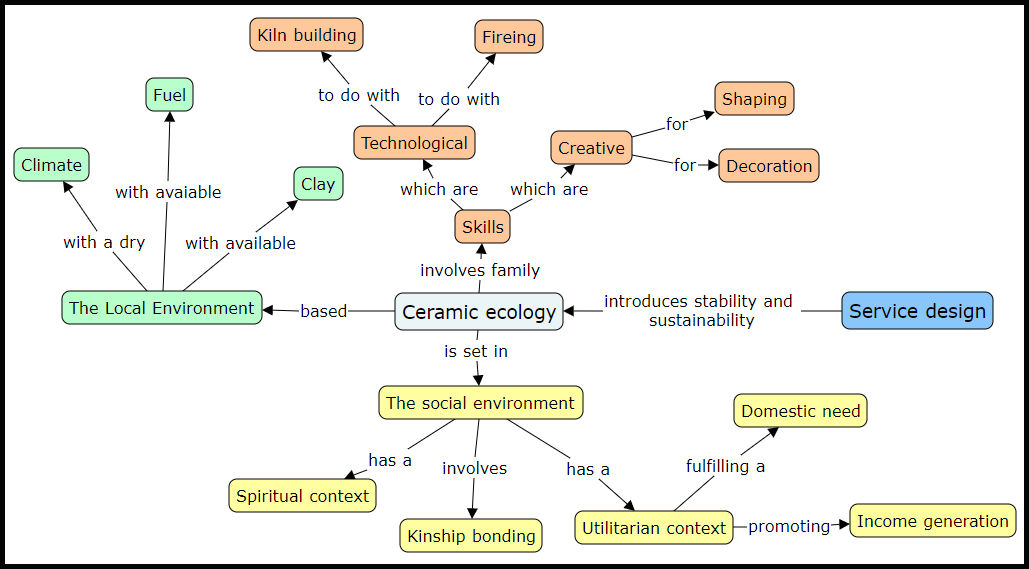
This idea of a commonality of nature was at the centre of an EC LIFE Environment Programme, which, at the end of the 1990s, funded work on the natural economy syllabus by bringing together people and business in order to cooperate in managing the community’s green commons.  This expanded the mind map around a cultural viewpoint that natural values of the environment are imparted by society to define heritage.  The teachers appropriated the name cultural ecology for this new topic tree, for a collection of on-line pages of which natural economy was a part.  Anthropologists to encapsulate the behavioural adaptations of native societies with their environments that made distinctive local cultures had first coined the name in the 1920s. 
 
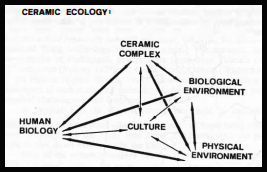
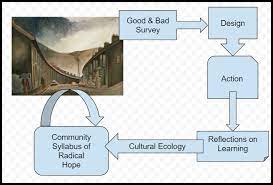
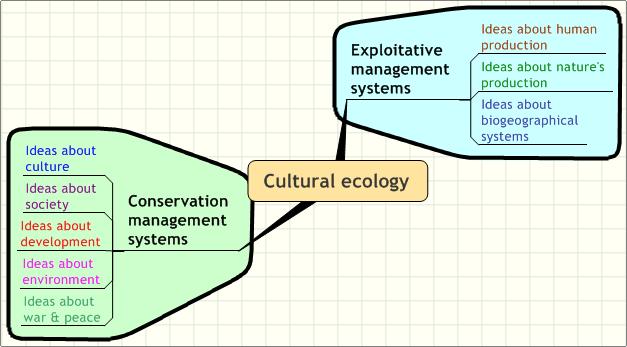
Culture is a complex clutch of ideas that a particular society has adopted to live by.  Applying these ideas to religion, art and science influences the way society ‘cultivates’ nature.  For example, the intersection of religion with environment produces moral goods, which have been described as ‘sacramental commons’.  There is also a flow of ideas from our uses of nature into society, which influences culture.  This two-way interaction between environment and society is the ideational topic scaffold described as cultural ecology. Cultural ecology is a more comprehensive educational framework for environmental education than natural economy.   It presents exploitative management of natural resources to meet the needs and wants of life coupled with conservation management of natural resources to maintain their flows and protect special places of an evolving biological diversity and beauty that may be called sacred.  Its eight or so topic headings are classroom slots in a mind map that can be customised with local information, to delineate traffic in men, materials, messages, and law that makes a community’s economy grow yet remain self-sustainable through local management of its inputs and outputs.  Conservation management balances the intrinsic values of nature against its instrumental values, and cultural ecology presents preservationism and resourcism as the two interlinked social movements of world development.   Cultures differ with respect to the formal arrangements for decision-making about the environment prevailing within a definite territory and interacting with different kinds of community units.  Community is defined by local cultural practices and a common neighbourhood history.  The roles of people in social units depend on their distribution as workers within resource systems; their organisation as families and individuals through demands on resources, goods and services; their participation as activists in the process of social development; and their belief as individuals with community bonds and some kind of value system of which humanity is at one with nature and history.
 
These four economic categories broadly match the four main conceptual pillars of cultural ecology as an educational concept.  They define a community according to the ways in which it exploits resources through production and demand.  They also define its approach to social development.  Today the latter is bound up with the conservation of resources through applications of science to environmental management, and/or, working through nature as one ’solar economy’, which includes all living things.  Within this holistic educational scheme, communities may be compared under the four headings of ‘distribution’, ‘organisation’, ‘participation’ and ‘belief’.  Distribution maps the community in relation to resources and jobs; organisation describes the lives of families and individuals; participation covers action for local development; and belief is exemplified by respect for living things and a sense of ‘place’. 
 
Nature conservation is the link between natural economy and political economy.  It is the accounting and management system of biodiversity for communities and governments; a counterbalancing response to economic development and an effort to make markets more harmonious with the dynamics of biophysical economies.   To this end, as living organisms with the rest of nature, we have to audit, protect, and manage the rest of nature upon which we depend.  We have to do this in order to match markets with ecosystems, which provide the natural resources for economic development, and are sources of the non-marketable environmental goods emanating from scenic beauty, and nature study.  There is a need to integrate environmental care and development under the guiding principle of ’sustainability’. Furthermore, we have to promote the idea that biodiversity is still a vital stock in the human survival kit and make people in all walks of life aware of its vital importance for the future of planet Earth. 

 
Cultural ecology is the only educational framework broad enough with the necessary flexibility to support a quest to find and answer practical and moral questions about the kind of world we want to live in, what kind of environment it should be and what we have to do as individuals, families, communities and nations to maintain a technological society.


A time-place curriculum

January 8th, 2007

There is something profoundly disturbing in making a random collision with a relative you didn’t know you had.  As an epiphany it is reworking of nature that is culture.  There is an ambiguous legacy of that On the other hand, the mental impact of connecting with a long lost relative gathers up some of the intellectual disorder underpinning one’s personal time-place curriculum, moving it towards a more robust and productive ideal.  Forget the fact that our common ancestor died centuries ago.  Skip over the many generations that had swirled away in an ever-expanding gene pool from the neighbourhood where it had gently rotated since Saxon times.  We have homed to each other, Internet-sure, straight as a missile or a magnet swinging to the pole.  We have known each other forever.  We speak the same language, although we may not yet know the architectures.  This is not a matter of genetics.  The likelihood of us expressing any of the behavioural genes that brought together two young people in an isolated pre-industrial rural community is practically zero. Nevertheless without this lost love sanctified through baptisms in a tiny church, which our ancestors would still recognise, we would not be together. 
 
Their church is our time machine; its navigators are the procession of priests down the ages assiduously recording their parishioner’s rites of passage.   On entry we accept the limits to human perception and language in the otherness of countless unknowns.  Spectres wait on tapes of stone to play endlessly off the walls for those who want to listen.  It is an otherness that sits along the margins of parish books like a whisper.   Nevertheless, today’s bond is a stabilising strut in world far wider than the old closed box of extreme rurality.  It is a cultural matter of focusing a common history of family with a love of place.  As a reworking of nature it is also an ecological matter.  It adds order to a placeless post-industrial environment where day to day we stumble about in an infinite space full of messages circulating freely without fixed destination. Culture and ecology come together with a vein of spirituality because it is about possessing a place through love, a painful process unless you can share a destination on common ground. Love is also the ecological cement of family:-
 
The only way to get out of the pain of possession
and insecurity is moving toward the love of others.
The more love we give the less insecure we will feel.
The more we share the more we love.
 
All of this demonstrates how easy it is to fall into history from a platform of family and kinship.  History lives on through making kinship connections with places where significant family events have happened. Families, not kings and queens, really embody our connection with the past.  This route has a wider perspective than the school subject because it is very strongly and specifically rooted in place, but is also led through love into the weave of a wider cosmos.  According to Freya Mathews the ecological self is an expression of this oneness and interconnectedness.
 
Genealogical research strengthens the self because you have taken responsibility for revealing the development of your family and locked on to its diaspora.  Human development through evolution and social learning is a powerful cross-disciplinary framework of cultural ecology. It is a recurring theme in every realm of knowledge: the universe, planet Earth, life, human technologies and families. This theme is actually the basis of the most recent time-place curriculum in cultural ecology.  Called ‘Voyages Through Time’, it has been produced, for a one-year high school course by the SETI Institute.  It takes a cultural view of the ecological relationships between people and their natural, social and created environments.  The materials, for what is essentially an integrated science course, are presented in six modules; Cosmic Evolution, Planetary Evolution, Origin of Life, Evolution of Life, Hominid Evolution, and Evolution of Technology.   The core lessons for the modules are provided on teacher CD-ROMs, which contain instructional guidelines, science background information, IT resources as well as student handouts.
 
The essential non-scientific family/kinship portion of a time-place curriculum is missing in the SETI syllabus.   To gain an inkling of the importance of adding a kinship agenda we may turn to National Grandparents Day. This also originated in the United States when a West Virginia housewife, Marian McQuade, initiated a campaign in 1970 to set aside a special day to celebrate grandparents.   The first Grandparents Day was proclaimed in 1973 in West Virginia by the state governor.  In 1978, five years after its West Virginia inception and much lobbying, the Congress passed  legislation proclaiming the first Sunday after Labor Day as National Grandparents Day. Jimmy Carter, the homespun president, signed the proclamation.  Now, millions throughout the United States observe this event begun to meet the needs of a few concerned about the dissolution of kinship.  It is one American invention that has not yet become embedded in our calendar.  Yet traditional kinship patterns throughout the West are in dramatic dissolution today, as heterosexual marriage declines, biological and social parenthood become dissociated, and homosexual unions are legalized.
 
Twenty years ago I was involved with a team of curriculum developers who were trying to launch a Great Grandparents Day in Welsh schools.  This was as an initiative to personalise the study of history and locality as part of the time-related cross-subject classroom topics of ‘change’, ‘continuity’ and ‘citizenship’.  This project coincided, in middle age, with my first stumbling efforts to find out where my great grandfather was born.  The starting point to develop this kinship aspect of a time-place curriculum was that, as individuals, our first knowledge of ourselves is that we are alone, and our dream of ourselves is we are alone because we are unique.  Not surprisingly therefore, everyone searches for a place where they belong.  Thinking about human history as a meeting with ancestors inevitably involves attaching the imagination to places; hence I gave the report of my first excursion into the ancestry of my parents the title ‘Meeting Places’.  Its subtitle could have been ’sharing places’ because mapping and sharing ones roots with family and friends are practical navigational procedures.  Trails we discover or create through ‘drifting’ and playful exploration of genealogical records can also form the basis of personal narratives. In this sense, a kinship narrative is part of the wider cultural environment required for the emergence and stabilisation of self-realisation.  This wider environment itself constitutes a greater self-maintaining cultural system, which we have to customise successfully in order to live and work.
 
In Ben Russell’s Headmap Manifesto, ‘the journey’ is a central idea bringing together human culture and environment. A journey is a fundamental way in which we relate to our notional lifetime achievements and to space.  Notionally, we move upwards according to our projects and achievement targets.  We move laterally in space from one place to another in a more erratic sequence. The idea of the life journey is central to our myths and stories, it is encoded in our architecture and implied in our built environment; the streets outside our houses, the paths through the woods, the networks of roads we travel, the railway tracks through our towns, the airports on the outskirts of cities, the ports distributed along every coast.  Meeting up with kinfolk sharing the family name of either of your parents is an obvious starting point to begin a headmap, but names are an arbitrary and biased beginning.  We each have two parents, four grandparents, eight great-grandparents, etc. Current technology permits us to link via DNA analysis to only two specific lines. On the Y chromosome, one’s father’s father’s DNA, going back as far as we can locate the genetic material, can be determined with a high degree of certainty. On the female side, mitochondrial DNA can link one’s mother’s mother’s mother going back as far as we can garner the DNA. So, while we have 64 great- great- great-great-grandparents, the technology allows us to locate only two of those 64, if we’re going back six generations.  But what of the other 62?   Those people are equal contributors to our genetic makeup, and we ignore them only because we do not have access to them.  In other words, it’s fine to follow one line of kinship rather than another according to the fruits of the journey.  Twin studies suggest that genes only account for 40- to 60-percent of the variation in human psychological traits.  The influence of genes is probably less because this kind of numerical summary implies a scientific certainty that doesn’t exist because of the interplay between genes and environment.  So what about the influence of non-biological parents who definitely sit in a separate kinship sequence, which governed their descent and alliance.   Fatherhood and motherhood of people not sharing their child’s genes can profoundly influence a child’s personality for better or worse, just as can blood line parenting.  Also, persons cut off traumatically and irreversibly from their genetic roots are known to have stabilised their selfhood by adopting the ancestry of an influential personality by proxy.
 
Apart from kinship, there are at least three other ‘meeting places’ in the context of establishing personal links between environment and history to discover selfhood.  These are localities where we make use of  ‘nature’, deal with ‘conflict’ and search for ‘god’.   Together with places where we can establish kinship, it is these four social pillars of cultural ecology that truly comprise a personal time-place curriculum.  The curriculum can be used to personalise the more technical pillars of cultural ecology, which deal with balancing the utilisation of our planet’s natural resources with their conservation for sustainability.  Overall, self-knowledge about this culturally endorsed cosmology encourages the search for shared values in planet and cosmos to defuse confrontations where self interest, on one side or another, is seen as a supreme virtue.
 
Practically, there is no guarantee that meeting up with a previously unknown blood relative will work out in any way.   We quickly sense how that individual experiences herself. We sense the level of that person’s excitement or the lack of it. Our instant attraction or non-attraction is automatic because our bodies and emotions respond faster than thought can take shape in words.  Each person is a unique being and we discover at this moment what the other person possesses to complement our lives. Hopefully, we sense that a union with such a person can bring new possibilities, which can make our existence richer. This is not to say this newfound person is the only one who can be in the right place at the right time. There may be others. For this reason, it has been concluded that, for each person, more than one other self exists.  Through these persons we acquiesce to love as an attachment to another self and to all worlds.  The poet E. E. Cummings expressed this time and again his poems, which celebrate saying ‘yes’ to love, sex, time and place.
 
love is a place
& through this place of
love move
(with brightness of peace)
all places
yes is a world
& in this world of
yes live
(skilfully curled)
all worlds
 
We eventually emerged from our particular shared ‘world of yes’ into the dying day of the winter solstice.  There were thoughts in common about real people of the past who had once upon a time also returned through this very door.  From a state of otherness they emerged to the view we see virtually unchanged today, mentally blinking from the numinous environment of marriages, baptisms and deaths. My immediate connection with the reality of nature is a nearby bush pressing against a small gravestone.  It has  been nourished by the bones of an infant, two hundred years old, with my mother’s name and possibly a small footloose part of my DNA.  The cosmos is represented by a transient splash of the setting sun at the end of its winter traverse; a reminder that rhythms of time affect everybody and whose celebrations were once genuinely communal. 
 
The trinity of bush, bones and sun, remind me that for human beings to flourish requires that we view ourselves within our culture as selves-within-wider-selves. Here I have to go with Freya Mathews. Maybe the feeling we call love is really the faint psychological shadow of an inner spirituality of which our oneness with the cosmos is the external manifestation.  A time-place curriculum within cultural ecology is necessary to provide the personalised ideational scaffold or mindmap to navigate from one to another.
 
Mathews, Freya. The Ecological Self (1991) Routledge
 
Russell, Ben. Headmap Manifesto (1999). Available online at http://www.headmap.org/headmap.pdf
 
SETI http://www.seti.org/site/pp.asp?c=ktJ2J9MMIsE&b=181004


Ecosacy

December 29th, 2006

In the late 1980s, a small group of educators in the United States set out to develop courses, curricula, and resources with implications for ‘a living in the universe story’. Their efforts cast seeds, which cast further seeds, bonding with multiples of other efforts across the world. Around this time I became involved with a UK initiative, kick-started by the Duke of Edinburgh, to create a new subject for the Cambridge Local Examinations Syndicate.  At an informal dinner party at Buckingham Palace I suggested that the mood was to create a culture, where ‘ecosacy’, the language of environment, was taught together with literacy and numeracy; all three being required for a balanced view of society. My definition of ecosacy was an ability to conceptualise the wholeness of self and environment as a set of beliefs to live by and a practical context that gives meaning and continuity to life.  To be ecosate means having the knowledge and mind set to act, speak and think according to deeply held beliefs and belief systems about people in nature as one community of beings. This means, as Scrooge’s nephew in A Christmas Carol points out, we should treat all people as ‘fellow-passengers to the grave and not another race of creatures on other journeys’


There was general agreement but no one could see a practical way forward unless there was a root and branch reform of the education system.  When the British national curriculum emerged it was just a re-jigged version of the Victorian prescription that had been designed to expand an Empire. Its contemporary aim was to maintain national economic growth between 2-3% year-on-year, for ever.   There was no mandatory architecture for the pillars of sustainable development and its associated cross-curricular topic work, which start with issues of living in an overcrowded world and centre on conservation management of nature’s assets.


I left Prince Phillip’s soiree with Angus Ogilvie, and we spent the rest of the evening in the Athenaeum where I was staying overnight.  Here we were joined by a group of senior civil servants in the Overseas Development Administration, and this chance meeting was to lead to several visits as an educational advisor to Nepal where the ODA was funding a public school, under the patronage of the Nepalese Royal Family.   The objective was to produce an educational model of Nepal as an exemplar for the new middle school subject that I was developing with teachers in Cambridge.  The subject was to be called ‘natural economy’.   Economic development was to be balanced against conservation management of landscape, wildlife and natural resources.  In other words, natural economy deals with the organization of natural resources for production.  It is complementary to political economy, which deals with the organization of people for production.


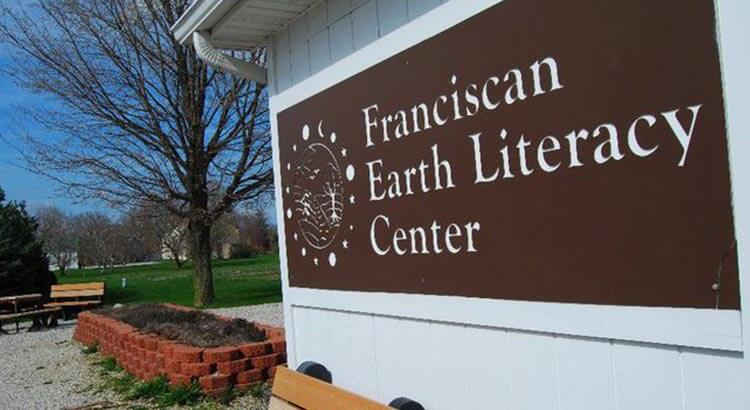
In Nepal, I first made contact with Buddhism as a religion working with the grain of nature.  Some seeds were set, and partially developed through discussions with a postgraduate Nepalese student in my department, which set me thinking about spiritual values of natural resources, an area now described as ‘deep ecology’.  By the turn of the millennium this became a small, fragmented, but committed movement on a global scale.   One focus for widespread discussion was the Earth Literacy Web, where the organisers’ questions at the Millennium indicated a strong educational sentiment at that time.


“What is Earth asking of us at this moment? What if we saw ourselves as a movement giving voice to an emerging Ecozoic era? What if we viewed Earth as a connection of webs (European, Asian, Australian, African, South American, and North American), an integral Earth Literacy “campus” with each of us and countless others invited to become a vast community / faculty of learning? What if we begin to envision and design regional gatherings over the next 5-10 years, working together to host conferences and provide immersion experiences for people interested in learning about the Universe Story in settings closer to their home regions? What if we believed that we could become part of a communion with what can only be described as a sacred purpose to create a vibrant, regenerative Earth community?”
 
The idea of an earth literacy web is just one of many convergences of the diverse creativity of many individuals, organizations, and institutions.  They mark a beginning to organise the task of educating people to accept, protect, and foster the remnants of our living Earth within this large cultural, cosmological context.


The idea of citizen’s environmental networks for local education and action had in fact emerged in the nineties with the lead up to the Environment Summit in Rio di Janeiro, which took place in 1992.  Two years later, on International Earth Day, I gathered a group of teachers and students on a mountain top above the Neath Valley in South Wales overlooking the biggest open cast coal mine in Britain.  The site, Maes Gwynn, was being landscaped by the National Coal Board.  It was to be re-soiled and vegetated, then fertilised with tanker loads of processed human sewage to create a country park.  We were there to reflect on where we are, what we are doing, and what we need to do in the future as we live into a revolutionary new Earth/human relationship. It soon became clear that everyone had memories of vast, unbounded skies, seas, jungles and wild animals; of mountains, deserts, infinite starry nights, underwater universes, flocks of migratory birds, exotic animals and the bounty of numberless small farms.  But they had been obtained from television documentaries. In front of the next generation, the teachers faced the shock that it was members of their great grandparent’s generation who were the last to have seen, heard, tasted, and touched the smaller, yet equally powerful wonders of nature in their Welsh countryside. From this gathering eventually came the School and Community Agenda 21 Network (SCAN), a bilingual web resource for Welsh schools to help the communities they serve with plans for sustainable development.  However, this is an optional add on and not a radical syllabus change.


A common response of teachers who have made contact with the Cambridge natural economy syllabus is, ‘I wish I had been taught this at school’.  However, since that would mean replacing at least two traditional subjects, biology and geography, natural economy has only been taken up in schools operating the more flexible International Baccalaureate, or where, as in Namibia, there was a total re-evaluation of the old subjects. Most schools are unable to ideate culture and ecology and bring them to the centre of the curriculum  


Prince Philip’s response to natural economy was a wish to see it extended to integrate with an ecological/conservation management dimension.  This challenge was taken up by the ‘Going Green Directorate’, an informal grouping of teachers across the UK, and with the help of sponsorships from industry and the EC cultural ecology has been assembled as a web-based annotated mindmap (see my blogroll).  The hope of the GGD is that this provisional interactive learning framework will help people build their own personal body of knowledge to take a political/practical stance on society’s ever-increasing ability to disrupt environmental systems on a large scale.

Someone other

December 24th, 2006

It’s about half past eight in the morning on the shortest day of the year, and I am musing about time, destiny and lifetime achievements.  Through the window I scan the small wood across a road, now busy with the local school-run, waiting for the rising sun to enliven the bark of an old oak and turn its neighbouring yew tree from black to green.  Because the house is higher than the road I have the impression of looking into a wildwood, a primeval scene rich with intertwining branches and fallen boughs, which occupies all of the window space.  Indeed, the twenty or so acres of alders and willows are called ‘the wild gardens’.  It is an unruly portion of a park designed by public-spirited Victorian worthies to preserve a small intractable wetland that was of no use to the Marquis of Bute’s agents as profitable real estate.  Since then it has been left largely to its own devices, the major management task being the occasional resurfacing of footpaths through what is essentially a small swamp. 
 
I am thinking that on this day of the winter solstice, through thousands of millennia, many an anxious glance was cast skywards, particularly towards the east when, like today, the murk looks especially thick and threatening. The particular view I am waiting for, of a veteran tree illuminated at sunrise, may not materialise at all, but this day really does mark the cosmic turning of the year.  Significantly, it is another a notch in my lifetime, but also a symbolic reminder that our personal spiritual universes are profoundly seasonal.  To generate new intellectual thrusts we need autumn and winter as symbols of the great resurrections of spring and summer.  In this sense we are all time-travellers.  Our capacity to find symbolical means of dealing with the fears of being alive is one of the most striking characteristics of humankind. When in need, we seek symbolical expression as well as practical fulfilment of those needs.  Many of the rituals devised by our ancestors arose out of the anxieties that inevitably afflicted human beings living precariously in the wildings of our early biological and social evolution.  With the sense of being an individual came fears that the vegetative forces of regeneration might wear out and the crops fail.  These fears gave rise to the fertility rituals, sacrifices of animals and the first fruits, practiced by human communities all over the world.  Fears that the winter solstice might not mark the end of the sun’s withdrawal over the horizon and the beginning of its return explain the ubiquitous existence of solstice rituals, saturnalia, orgies, and so on.  These represent behavioural inventions in a game against nature.  They are more likely to occur in societies where the prevailing system of beliefs reinforces the propensity to change production methods, which is an indication of the willingness to challenge and to manipulate the physical environment.  This is the context in which the anthropocentric philosophy of Judeo-Christian religion represented an exceptional mental shift in human history when it was taken for granted that God emerged to govern all cosmic forces for the benefit of His people. “And God saw everything that God had made and behold it was very good (Genesis 1.31)”.
 
Ever since I can remember I have had a powerful timeline in my head.  A person within me hovers and glides to and fro from the relatively short human lifespan, through a patchy ancestral past to an uncharted eternity, searching for symbolic links between past and future. Egypt, of course, had a very sophisticated idea of what happens after death, even though this afterlife was reserved for a select few.  The Jewish Talmud heralds the next phase of immortality for everyone in a ‘World To Come’. The earliest reference in rabbinic literature comes in Avot.  “Rabbi Yaacov said, ‘This world is like a corridor; prepare yourself in the corridor so that you can enter the palace’.  The rabbis and the Muslim theologians avoid going into any greater detail. The ‘Garden of Eden’ is one analogy and “the palace” is another, but with no details specified, this is as far as one gets. The priests are eager to assert the promise of something better but they feel no obligation to say what it is like.  So those like me who prefer a more concrete authority to commit to the concept of eternal life inevitably look within themselves for a lifetime guide to provide an understanding of the only life we will ever have.
 
Laurens Van der Post, in his mid-70s, actually envisaged this lifetime guide as his boyhood self, who survived on a spiritual frontier in the role of critic and mentor of his adult life.  This imaginary being he called  ’someone other’.  This is the childhood comparator we all tend to return to for remembrance and affirmation of values that, for one fleeting moment were everything, but then became buried deep with the onward rush of the experiences of growing up. Youth not only comes into focus in later life, but life is compressed so things that happened decades ago appear as fresh as yesterdays.  Also, the most significant factor in the psychology of getting old is that one becomes more that self that never grew up. 
 
Van der Post singled out the Cape of Good Hope as his physical symbol of transition.  Here it was, as he sailed away from his South African homeland for the last time, that he contemplated the Portuguese age of discovery.  To Portuguese sailors the Cape was a landmark and a symbol of nationhood as colonisers of half the world.  Laurens’ mind-set shifted from the technology of ships and marine chronology, which were symbols for charting the old Earth, to space travel as a symbol of hope for the new spiritual challenges of research to conquer the wider cosmos.
 
Writing about his personal distress on departing Cape Town on the last of the great passenger liners he reflected on what the reality of the Cape meant in the imagination of the first European explorers.
 
“Some four hundred and fifty years before, the great Camoes had seen the Cape vanish astern of a ship in which he was one of a handful of survivors of the original crew bound for home. He had sailed on from there over the same swinging water to write in his epic Lusiad what that journey and that view of the Cape had done to him. The powerful symbolism of his description, drawn from the kind of intuition of which I was thinking, bore witness to the Pentecostal nature of all art, and shone out as another and greater light than the one just extinguished on my own heaving horizon”.
 
In contrast to Van der Post, I am trying to grasp a much less dramatic topographic reality, a captive wildwood in the local municipal park, with two external planes or dimensions of the imagination.  One plane is the objective world of science concerned with the flow of solar energy into living beings.  As a post graduate student my objective was prove that cells across the animal kingdom have particles in common that confine them to planets with an atmosphere of oxygen.  It turned out these particles were bacteria accidentally incorporated into a protozoan ancestor at the dawn of time.   The other plane is the dimension that is not yet, and probably never can be, fully described in the objective language of science.  Outside my window, that Yew tree, now turning green with the brightening sky, is part of the ‘It’ of an ecosystem taking in the weak energy of the winter beams to maintain life.  For the ecosystem to become a spiritual model in relation to me, the ‘It’ has also to be a ‘Thou’ in my relationship to it as part of the cosmos, which has a subjectivity answering to my own in that I am getting closer and closer to returning to stardust.
 
Prehistoric stone observatories tuned into the cosmos are evidence that in northern Bronze Age cultures the universe was addressed by prehistoric people as ‘Thou’.  The uncertain world that faced them on the shortest day was not just a collection of mere objects to their subjectivity.  Their adaptive response was to create a culture entrained to an annual cycle of ceremonies in which the community could align itself with the conjunction of numinous ecological power embedded in the family life of neighbours.  The turning of the year was always a time to be anxious.   It is also a time for rites of passage by which their perceptions of a cosmic ‘Thou’ could be perpetually recreated, and appropriated by the community and the individual.   Magic is expressed in the intuitive inextinguishable hope that inspired them to believe there was a future for family and community.  A solstice came to be anticipated as a ritual moment that is particularly likely to create a personal disclosure or symbolic meaning.   Even when religion had passed into more and more sophisticated phases of expression, important new personal perceptions of religion experienced by seers and prophets often emerged during a particular ritual enshrined in the devotional calendar.
 
There is a magic of human destiny and group ambition in these prehistoric stone structures, which I suppose I am trying to re-capture at this moment by projecting my thoughts at two ancient botanical beings across the road.  It is through these thoughts that I also connect with those infinitely remote men and women and their uncertainties when everything seemed dying around them in the darkest days of the year.  What they were about touches me today.  I was reassured by the sky brightening from the east although the first shafts of sunlight did not hit my personal woodland targets today.  It actually burst upon my computer screen as I was writing this story in the late afternoon.  The computer is part of my world of objects, one of countless ‘Its’.  I am also a spiritual being who must establish personal relationships with the cosmos.  As an heir to the Bronze Age sun worshippers, my someone other, somehow, gives me the intellectual confidence to say, albeit under my breath, ‘Welcome, thou Sun!’.  Tomorrow’s day will be slightly longer.
 
What I am really saying is that there is an urgent need for an educational framework that can accommodate both extremes of the tangible and the numinous.  In this context a municipal park is an expression of cultural ecology.  The need for linking culture and ecology and its educational significance to urban dwellers like me was summarised by Frederick Law Olmsted in his plan submitted for the creation of Central Park, New York, in 1857.  This was to be a rugged and natural design which rejected the standard civic pastoral copses and lawns. In Simon Schama’s words, “something of New York’s own original wilderness ought to be preserved” because in Olmsted’s rationale:-
 
“The whole of the island of New York would… be occupied by buildings and paved streets; that millions upon millions of men were to live their lives upon this island, millions more to go out from it, or its immediate densely populated suburbs, only occasionally and at long intervals, and that its inhabitants would assuredly suffer… according to their occupations and the degree of their confinement to it, from influences engendered by these conditions”.
 
In other words, at one pole, education for a largely urban population has to accommodate the religiousness of Einstein, who wrote, “To sense that behind anything that can be experienced thee is a something that our mind cannot grasp and whose beauty and sublimity reaches us only indirectly and as a feeble reflection, this is religiousness.  In this sense I am religious”.  It also has to place equal emphasis on the theory of evolution and the periodic table of elements.